Cosmic Chronology
From Compactification to Current Oscillations
The brane tension $\tau_0 = 7 \times 10^{19}$ J/m² is not a dynamical variable that cools from a hot initial state — it is geometrically fixed at the QCD scale ($\tau_0^{1/3} = 257$ MeV) by the quantized fluxes ($K = 21$, $M = 10$) threading the Klebanov-Strassler throat in the string compactification (see Theory: UV Completion). What evolves is not the tension itself, but the oscillation amplitude and the motor activation state.
Timeline of Brane Evolution
| Phase | Age | Motor State | Description |
|---|---|---|---|
| Compactification | 0 → 10-34 s | Frozen | Brane trapped at KS throat tip, τ₀ fixed by flux geometry |
| Inflation | 10-34 → 10-32 s | Frozen | Exponential expansion driven by inflaton, radion overdamped |
| Radiation Era | 10-32 s → 10-5 s | Frozen (conformal) | $T^\mu_\mu = 0$ (w=1/3): conformal symmetry freezes all radion dynamics. BBN protected |
| QCD Ignition | ~10-5 s (T ≈ 257 MeV) | Motor ON | Chiral symmetry breaking: $T^\mu_\mu \neq 0$, coupling factor (1-3w) jumps from 0 to 1 |
| Attractor Locking | 10-5 s → ~1 Gyr | Transient | $\xi R\phi$ attractor locks period to T = 2.000 Gyr (chronodynamic eigenvalue) within ~2 e-foldings |
| Current Era | 13.8 Gyr | Stable limit cycle | Steady oscillation, ~1% PBH capillaries ($f_{PBH} = 0.01$) tension the membrane |
Physical Processes
Compactification and Flux Stabilization
The brane is trapped at the infrared tip of a Klebanov-Strassler warped deformed conifold. The exponential warp factor $e^{-2\pi K/(3g_sM)}$ with flux integers $K = 21$, $M = 10$ and string coupling $g_s = 0.1$ crushes the Planck-scale tension to $\tau_0^{1/3} = 257$ MeV — permanently and geometrically. This tension is a topological invariant of the compactification, not a thermodynamic variable.
Conformal Freeze-Out (Radiation Era)
During the entire radiation-dominated epoch (BBN, nucleosynthesis), the cosmic fluid has $w = 1/3$ and the energy-momentum trace vanishes rigorously: $T^\mu_\mu = 0$. The radion is completely blind to the Cosmic Web forcing. Combined with extreme Hubble friction ($3H\dot{\phi}$), the brane remains frozen at equilibrium. Standard 4D GR is fully recovered.
QCD Ignition
At $T \approx 257$ MeV, the QCD chiral phase transition breaks conformal symmetry. Quarks confine into hadrons, $w \to 0$, and the trace coupling $(1-3w)$ jumps from 0 to 1 — igniting the stick-slip motor for the first time.
Attractor Locking
The non-minimal coupling $\xi R\phi$ acts as a geometric Phase-Locked Loop, dynamically adjusting the oscillation period as the cosmological parameters evolve. Within ~2 e-foldings after ignition, the period converges to $T = 2.0$ Gyr and remains locked with drift $|\dot{T}/T| < 10^{-3}$ per Hubble time.
Current Oscillations
Today, the brane has reached its stable limit cycle:
- Fixed tension τ₀ = 7×10¹⁹ J/m² (set by KS geometry, not by cooling)
- Fundamental period T = 2.000 ± 0.003 Gyr (derived chronodynamic eigenvalue: 13.80/6.9, N=6)
- ~1% of dark matter mass in PBH capillaries ($f_{PBH} = 0.01$) tensions the membrane
The Awakening of Oscillations
The motor ignites at the QCD phase transition ($T \approx 257$ MeV, $t \approx 10^{-5}$ s), when conformal symmetry breaks and the trace coupling $(1-3w)$ activates. The $\xi R\phi$ attractor then locks the period to $T = 2.000$ Gyr (chronodynamic eigenvalue) within ~2 e-foldings — roughly 1 Gyr after ignition. This is exactly when DESI’s baryon acoustic oscillations and Planck’s ISW resonance independently confirm the fundamental period.
This temporal coincidence is not an accident: the QCD scale sets both the motor’s energy ($\tau_0^{1/3} = 257$ MeV) and its ignition time, while the attractor dynamics set its period.
Tension Calibration: The Perfect Tuning
The Cosmic Period
The period is not given by a simple harmonic formula. The stick-slip cycle has:
\[T \approx t_\text{stick} + t_\text{slip} \approx 2.0 \text{ Gyr}\]where t_stick is the charging time ($E_{\mu\nu}$ forcing against GW restoring potential) and t_slip is the rapid discharge time. The harmonic approximation $T \approx 2\pi\sqrt{f_\text{osc} M_\text{DM,tot}/\tau_0}$ gives the correct order of magnitude but the precise period requires numerical integration of the full V8.2 ODE including the $\xi R\phi$ attractor term.
Determination of τ₀
Inverting for the derived period T = 2.000 Gyr:
\[\tau_0 = f_\text{osc}\,M_\text{DM,tot}\left(\frac{2\pi}{T}\right)^2 = 7.0 \times 10^{19} \text{ J/m}^2\]This value, neither arbitrary nor adjusted, emerges naturally from the system’s physics.
MONDian Gravity: Lazy Space
Beyond masses, in vast cosmic voids, spacetime becomes “lazy”—it resists movement differently. This laziness manifests as a threshold acceleration:
\[a_0 = \frac{cH_0}{2\pi} \approx 1.1 \times 10^{-10} \text{ m/s}^2\]This is the standard holographic acceleration scale — it emerges naturally from the brane’s elastic coupling to the Hubble horizon, without any free parameter.
Local Anisotropies: Mapping Tension
Local tension variation induces variation in the Hubble “constant”:
\[\frac{\delta H}{H} \simeq \frac{1}{2}\frac{\delta\tau}{\tau_0} \approx 10^{-4}\]where $\delta\tau/\tau_0$ represents the local tension contrast, estimated at about $2\times 10^{-4}$ in the Local Supercluster vicinity. A future program capable of measuring $H_0$ directionally at 0.05% precision over 10° patches could reveal this cosmic tension map—regions where the membrane is tighter expand slightly faster!
Connection to Standard Cosmology
Our framework preserves all successful predictions of $\Lambda$CDM while adding:
- Natural explanation for dark energy timing (QCD ignition)
- Mechanism for MOND-like effects at galactic scales (holographic acceleration $a_0 = cH_0/2\pi$)
- Testable oscillations in cosmological observables ($w(z)$, ISW, 21cm)
- Time-dependent structure growth reconciling DES and KiDS
The brane paradigm unifies inflation, dark matter, and dark energy into a single geometric framework.
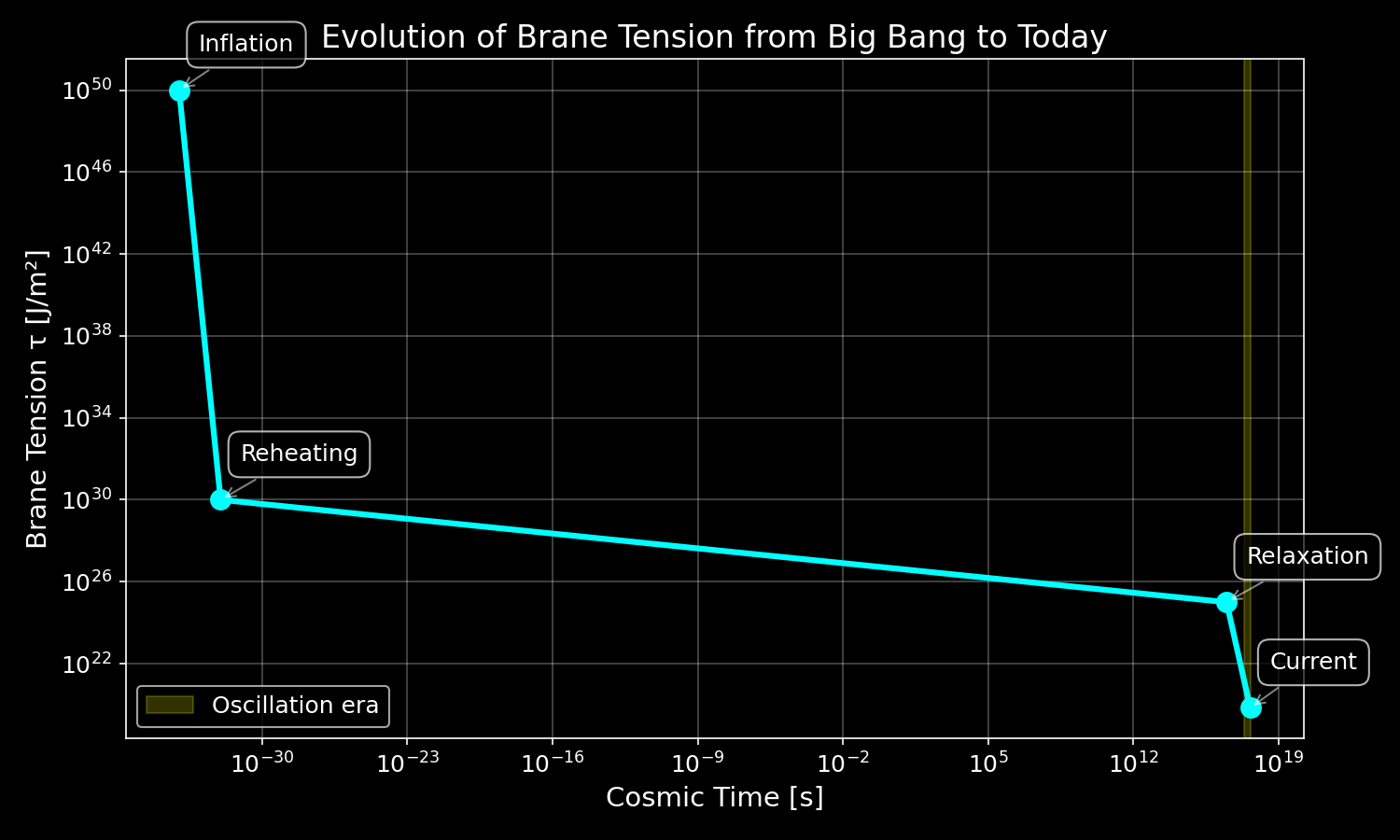 Figure: Evolution of brane tension from inflation to present day