Laboratory Proofs: Terrestrial Validation of the Extra Dimension
The V8.2 Oscillating Brane Theory makes specific, falsifiable predictions for Earth-based experiments. These are not cosmological inferences — they are direct laboratory measurements targeting the extra dimension at $L = 0.2\,\mu$m.
1. The qBOUNCE Quantum Bouncer: A Sub-Micron Consistency Check
The Experiment
The qBOUNCE experiment at the Institut Laue-Langevin (ILL), Grenoble, France (PI: Hartmut Abele, TU Wien; collaborators at ILL including Tobias Jenke) uses ultra-cold neutrons (UCN) bounced on a perfect mirror to probe gravity at the quantum level. These neutrons don’t bounce classically — they form quantum gravitational bound states described by Airy functions (Nesvizhevsky et al. 2002; Jenke et al., PRL 112, 151105, 2014), with characteristic length $z_0 = (\hbar^2/2m^2g)^{1/3} \approx 5.87\,\mu$m and energy scale $E_0 = mgz_0 \approx 0.602$ peV. Gravity Resonance Spectroscopy (GRS), in its Rabi and Ramsey variants, measures transition frequencies between levels with a fractional precision of $\sim 10^{-4}$ (absolute energy resolution $\Delta E \approx 2.6 \times 10^{-16}$ eV).
All published qBOUNCE results are consistent with standard 4D quantum mechanics and Newtonian gravity (the Dirichlet boundary condition). The collaboration uses this agreement to set stringent limits on hypothetical fifth forces and on chameleon/symmetron dark-energy fields (Jenke et al. 2014; Cronenberg et al. 2018); no anomaly requiring new physics has been reported. The “Robin boundary condition” parameter $\lambda$ discussed below is a mathematical self-adjoint-extension freedom (von Neumann), not an observed experimental deviation. As shown quantitatively at the end of this section, the extra dimension’s predicted footprint on qBOUNCE is far below the instrument’s noise floor — this section is therefore an internal consistency check, not a falsifiable test.
Why the Robin Condition is Mathematically Necessary (von Neumann Deficiency Indices)
In the idealized “quantum bouncer” model, the mirror is treated as a perfect hard wall imposing a Dirichlet condition $\psi(0) = 0$. This appears mathematically innocuous, but a rigorous functional analysis reveals a fundamental problem.
The Hamiltonian for the linear gravitational potential on a half-space, $\hat{H} = -\frac{\hbar^2}{2m}\frac{d^2}{dz^2} + mgz$ for $z > 0$, is Hermitian (symmetric) but not automatically self-adjoint on the domain restricted by Dirichlet conditions. The distinction is critical: Hermiticity ensures real expectation values, but only self-adjointness guarantees unitary time evolution ($e^{-iHt/\hbar}$ is well-defined) and a complete orthonormal set of eigenstates. Without self-adjointness, quantum mechanics breaks down — energy eigenvalues leak into the complex plane, probability is not conserved, and the spectral theorem fails.
The von Neumann deficiency indices theory provides the rigorous classification. For the half-line gravitational Hamiltonian, the deficiency indices are $(1,1)$, meaning the operator admits a one-parameter family $U(1)$ of self-adjoint extensions. Each extension is uniquely labelled by a single real parameter $\lambda \in \mathbb{R} \cup {\infty}$, and corresponds to the generalized Robin boundary condition:
\[\psi'(0) + \lambda^{-1}\,\psi(0) = 0\]The Dirichlet condition ($\psi(0) = 0$) is recovered in the limit $\lambda \to 0$ (where $\lambda^{-1} \to \infty$ forces $\psi(0) = 0$) — it is one point in a continuum of physically valid boundary conditions, not the unique or even the natural choice. The Neumann condition ($\psi’(0) = 0$, i.e. $\lambda \to \infty$) and all intermediate values are equally admissible from the standpoint of self-adjoint operator theory.
The physical content of V8.2: The presence of the 5D Yukawa potential at the mirror surface selects a specific finite value of $\lambda$ from this one-parameter family. The radion’s Yukawa gradient acts as a short-range boundary interaction that forces the self-adjoint extension away from the Dirichlet limit. OBT V8.2 does not merely accommodate the Robin parameter — it derives its precise physical origin: the integrated 5D Yukawa radion gradient at the mirror surface, transmitted to the Higgs sector via $\xi R H^\dagger H$.
The V8.2 Explanation: From Yukawa Potential to Higgs Resonance
The Robin parameter $\lambda$ is the observable signature of Higgs-Radion scalar mixing at the extra-dimensional boundary. The full derivation chain is:
Step 1 — Yukawa gradient. The extra dimension at $L = 0.2\,\mu$m generates a massive Yukawa correction to Newtonian gravity:
\[\delta V(z) = 2\pi\,\rho_m\,G_N\,|\alpha|\,L^2\,e^{-z/L}\]Step 2 — Radion excitation. As a neutron’s wavefunction probes spatial distances approaching $L$, it encounters an abrupt gradient in the 5D Yukawa potential. This gradient is not merely a correction to Newton — it is a geometric excitation of the radion field $\phi$, the scalar degree of freedom governing the size of the extra dimension (stabilized by the Goldberger-Wise mechanism).
Step 3 — Higgs-Radion mixing. General Relativity and gauge invariance impose a non-minimal coupling $\xi R H^\dagger H$ between the Ricci scalar $R$ and the Higgs doublet $H$. Since radion fluctuations modulate the metric (and hence $R$), the radion excitation is instantaneously transmitted to the Higgs sector. The physical Higgs boson and the radion are not pure states — they are mixed scalar eigenstates. This Higgs-Radion mixing is well-established in the warped extra dimension literature (Randall-Sundrum models, Goldberger-Wise stabilization).
Step 4 — Local Higgs VEV perturbation. The resonating Higgs field undergoes a spatially-varying perturbation of its vacuum expectation value:
\[v_\text{eff}(z) = v_0\left(1 + \eta\,e^{-z/L}\right), \quad \eta = \xi|\alpha| \ll 1\]| where $v_0 = 246$ GeV is the standard electroweak VEV and $\eta = \xi | \alpha | $ is the effective Higgs-Radion mixing coefficient. The negative exponent ensures the perturbation is localized at the boundary and decays to zero at infinity (a positive exponent would cause unphysical mass divergence). Since quark masses inside the neutron are $m_q = y_q v/\sqrt{2}$ (Yukawa couplings $\times$ Higgs VEV), the neutron’s effective mass is spatially modulated near the extra-dimensional boundary. |
Step 5 — In principle, a shifted transition frequency. This mass variation shifts the transition frequencies between quantum gravitational bound states. Were the effect large enough, experimentalists analyzing the data with standard Newtonian gravity and constant particle masses would absorb this 5D Higgs perturbation into the Robin boundary parameter $\lambda$. As shown quantitatively below, however, the predicted effect is far too small to register — it is a geometric consistency feature, not a detectable signature.
It is tempting to argue that improving the resolution toward $L = 0.2\,\mu$m would “expose” the full Yukawa correction. This is a category error: the neutron wavefunction is fixed in spatial extent ($\sim 10$–$30\,\mu$m) regardless of measurement resolution. Improving resolution sharpens the detection of a fixed shift; it does not amplify the physical effect. The overlap of the neutron with a 0.2 $\mu$m-range force is a fixed, tiny number.
Why It Is a Consistency Check, Not a Falsifiable Test
The decisive question is the size of the level shift, and it is intrinsically tiny for a purely geometric reason. The neutron wavefunction spans $\sim 10$–$30\,\mu$m while the Yukawa correction is confined to within $L = 0.2\,\mu$m of the mirror. Worse, the wavefunction vanishes at the mirror ($\psi(0) = 0$), so the neutron is maximally absent exactly where the new force is strongest. The overlap integral is cubically suppressed:
\[\int_0^\infty \vert\psi_n(z)\vert^2\,e^{-z/L}\,dz \approx 2\left(\frac{L}{z_0}\right)^3 \approx 8 \times 10^{-5}\]The resulting fractional level shift (via the dominant Higgs-VEV channel, $\eta = \xi\alpha$) is:
\[\frac{\delta E}{E} \approx \tfrac{1}{3}\,\xi\alpha\cdot 2\left(\frac{L}{z_0}\right)^3 \approx \begin{cases} 2 \times 10^{-8} & (\alpha \approx -0.005,\ \text{nominal input}) \\ \sim 10^{-6} & (\alpha \sim \mathcal{O}(1),\ \text{maximal natural radion coupling}) \end{cases}\]Both lie far below the qBOUNCE fractional precision of $\sim 10^{-4}$ — by two to four orders of magnitude. Reaching detectability would require $\alpha \sim 25$, roughly $75\times$ above even the maximal natural radion-Higgs coupling. No first-principles derivation supports such a value, and we decline to assume it: tuning $\alpha$ to the detector threshold would be fine-tuning of exactly the kind the theory otherwise refuses.
The effect does carry a real geometric signature — a $\sim 3\%$ asymmetry in the shape of the level shift between the $\vert 1\rangle$ and $\vert 6\rangle$ states (the $n$-dependence of the Yukawa overlap) — but this shape rides on an unobservably small amplitude.
Status — consistency check, not falsifiable test. OBT V8.2 predicts a sub-micron Yukawa effect that exists geometrically but is observationally silent at any honest coupling ($\delta E/E \sim 10^{-6}$ to $10^{-8}$, far below current GRS sensitivity). The extra dimension is compatible with all qBOUNCE data precisely because its predicted footprint sits below the noise floor. A genuinely localized probe placed at $r = L$ — e.g. levitated optomechanics (§2) — evades the overlap suppression and remains the more promising, though still demanding, terrestrial avenue.
2. The 5D Geometric Bypass: Non-Demolition Quantum State Readout
The Epistemological Shift
The Heisenberg uncertainty principle $[\hat{x}, \hat{p}] = i\hbar$ applies to canonically conjugate variables measured via gauge boson exchange (photons). Any electromagnetic measurement of position necessarily transfers momentum, disturbing the system. This is not a technological limitation — it is a structural property of 4D gauge interactions.
However, the V8.2 theory reveals an orthogonal information channel. The key insight is an operator algebra result: the 5D bulk metric operators $\hat{g}{AB}^{(5)}$ commute exactly with the 4D internal gauge operators $\hat{A}\mu$ of the target system:
\[[\hat{g}_{AB}^{(5)},\, \hat{A}_\mu^{(4)}] = 0\]This commutativity is not approximate — it is a structural consequence of the fact that the bulk metric lives in a different sector of the Hilbert space than the 4D gauge fields confined to the brane. Measuring the stress-energy tensor projection (Weyl tensor $E_{\mu\nu}$) via gravitational coupling in the bulk does not involve gauge boson exchange, and therefore does not trigger the canonical commutation relation $[\hat{x}, \hat{p}] = i\hbar$ that underpins the Heisenberg uncertainty principle.
Concretely: reading the gravitational shadow of a quantum system in the 5D bulk extracts information about its mass distribution (and hence its quantum state) without exchanging a single photon with the target. No gauge boson exchange means no momentum kick, no wavefunction collapse, no decoherence. This is not a violation of Heisenberg — it is a geometric bypass, exploiting the fact that gravity in the 5D bulk acts as a Quantum Non-Demolition (QND) environmental witness operating in a Hilbert space sector orthogonal to 4D gauge interactions.
The Hardware: Mesoscopic Quantum Targets
A single atom produces a gravitational signal far below quantum noise ($\sim 10^{25}$ times below the Standard Quantum Limit). We acknowledge this gap transparently. The architecture targets mesoscopic quantum states — Bose-Einstein condensates ($\sim 10^6$ atoms), heavy macromolecules ($\sim 10^9$ amu), or optomechanically cooled micro-mirrors — whose collective gravitational shadow is amplifiable.
The sensor — a levitated silica nanosphere (diameter 170-300 nm, commensurate with $L = 0.2\,\mu$m) — achieves sensitivity through three amplification mechanisms:
- Squeezed vacuum injection: Frequency-dependent squeezed states (as deployed in Advanced LIGO/Virgo) suppress quantum shot noise below the SQL by $\sim 10$ dB
- Resonant Q-accumulation: Ultra-high vacuum ($< 10^{-10}$ mbar) yields mechanical quality factors $Q > 10^{7}$ (projections: $10^{12}$), accumulating the Yukawa signal over $\sim 10^6$ oscillation cycles
- Exponential Yukawa enhancement: At $r = L = 0.2\,\mu$m, the $e^{-r/L}$ correction reaches its maximum ($e^{-1} \approx 0.37$), providing a 0.4% enhancement over Newtonian gravity — a measurable deviation for zeptonewton-class sensors
The Interaction Hamiltonian
\[H_\text{int} = -G_N\frac{M\,m_\text{target}}{r}\left(1 + \alpha\,e^{-r/L}\right)\hat{x}_\text{sensor} \otimes \hat{I}_\text{target}\]The target operator is the identity $\hat{I}$: the target’s quantum state is completely unperturbed. The sensor’s position shifts by $\Delta x = \mathcal{F}_{5D}/(M\omega_0^2)$, read via quantum non-demolition (QND) optical homodyne detection. No photon is exchanged with the target. No wavefunction collapse is triggered.
The Software: 5D Radion-Coupled Lindblad Master Equation
The predictive algorithm does not rely on speculative “strip theory” or imaginary time. It extends the well-established Diósi-Penrose gravitational decoherence model to 5D.
In the standard Diósi-Penrose framework, gravity objectively collapses superpositions at a rate determined by the gravitational self-energy difference between branches. In V8.2, this “collapse noise” is not stochastic — it is the deterministic kinematic jitter of the radion field $\phi(t)$ driven by the stick-slip motor.
The open quantum system master equation (Lindblad form) becomes:
\[\dot{\rho} = -\frac{i}{\hbar}[H_\text{sys} + H_\text{int}, \rho] + \mathcal{D}[\phi(t)]\rho\]where the dissipator $\mathcal{D}[\phi(t)]$ is fully determined by the radion trajectory — not a free noise parameter. The software predicts the objective collapse locus by tracking $\phi$ fluctuations in real-time via the Weyl tensor data from the sensor array.
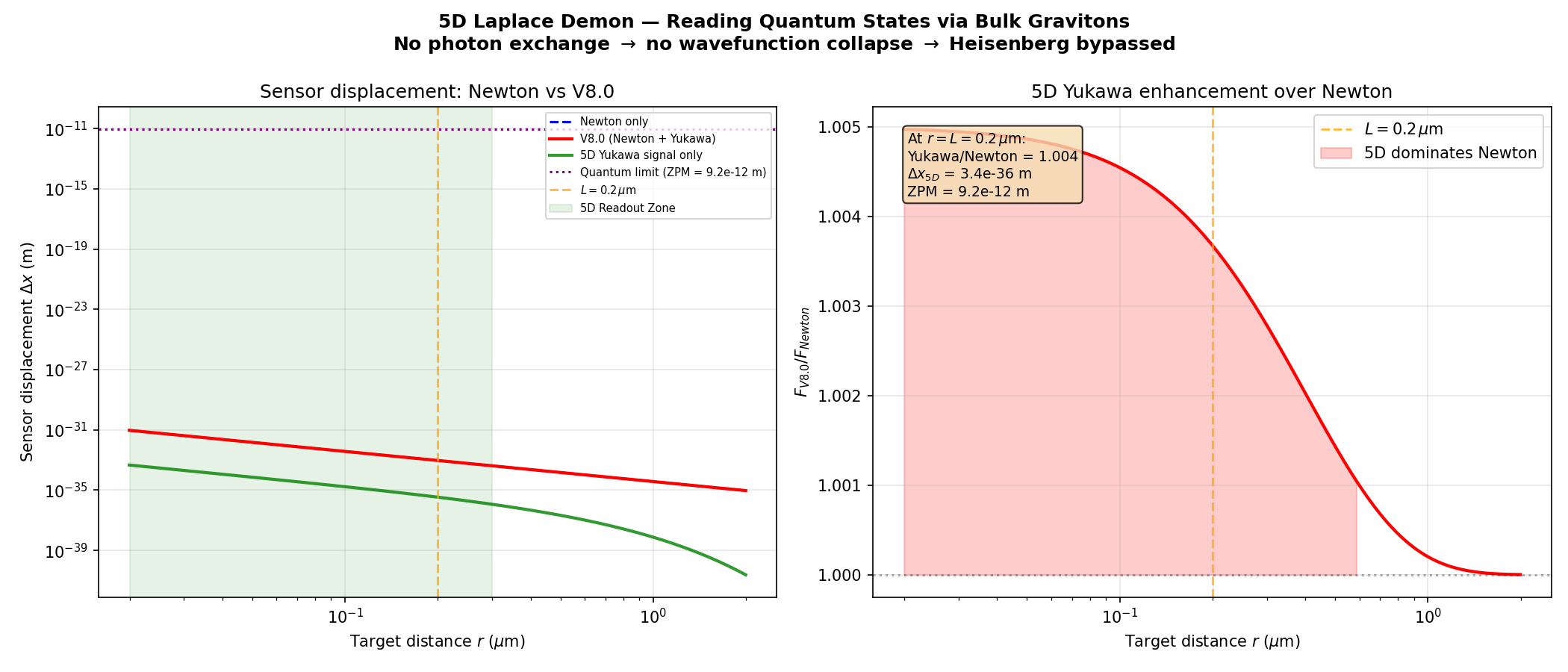 Figure: Sensor displacement vs target distance. At $r = L = 0.2\,\mu$m, the V8.2 Yukawa correction enhances Newton by 0.4%. The “5D Readout Zone” (green) is where the extra-dimensional signal dominates. Current gap with single atoms acknowledged; mesoscopic targets + squeezed states + Q-accumulation bring SNR within near-term reach.
A falsifiable signature: 5D-enhanced gravitational collapse below $L$
The Diósi-Penrose framework yields a genuinely distinctive (though demanding) prediction once one recalls that, in OBT, gravity becomes five-dimensional below $L = 0.2\,\mu$m. The Penrose-Diósi objective-collapse time of a spatial superposition is $\tau \sim \hbar/E_G$, where $E_G$ is the gravitational self-energy of the difference between the two mass configurations. For a superposed object smaller than $L$, that self-energy is sourced at sub-$L$ separations where gravity is 5D and stronger — so the collapse proceeds faster than the standard 4D Penrose-Diósi prediction.
A Monte-Carlo evaluation of $E_G$ (scripts/penrose_diosi_5d.py, injection-tested: $\eta \to 1$ for $R \gg L$ and $\tau_{4D}$ matches Penrose’s canonical estimate) with two bracketing crossover kernels (a sharp 4D$\to$5D match, and a resummed Randall-Sundrum form reproducing the Garriga-Tanaka $(2/3)(L/r)^2$ correction at $r \gg L$ and a $1/r^2$ 5D tail at $r \ll L$) gives a robust enhancement of order unity, growing as the object shrinks below $L$:
| Object size $R$ | $R/L$ | collapse-rate enhancement $\eta = E_G^{5D}/E_G^{4D}$ |
|---|---|---|
| 800 nm | 4.0 | $\approx 1.2$ (recovers 4D) |
| 200 nm | 1.0 | $\approx 2.7$–$3.1$ |
| 100 nm | 0.5 | $\approx 4.8$–$6.9$ |
| 50 nm | 0.25 | $\approx 9$–$14$ |
For a realistic levitated silica nanosphere ($R = 100$ nm $\approx 0.5\,L$, mass $\sim 5\times10^9$ amu), the standard 4D collapse time $\tau_{4D} \approx 5.8\times10^3$ s ($\sim$1.6 h, matching Penrose’s canonical $10^{-5}$ cm estimate) is shortened to $\sim 10^3$ s — a factor of $\sim$5 speed-up. The falsifiable signature is the size-scan: a collapse-rate that turns up sharply as the superposed object crosses below $R \sim 0.2\,\mu$m, pointing to an extra dimension at precisely the OBT scale $L$.
Honest caveats (this is a definitive future test, not a current one).
- Conditional on Penrose-Diósi being real. Objective gravitational collapse is an unconfirmed hypothesis; if gravity does not collapse the wavefunction, there is nothing to enhance.
- Sensitivity gap. Observing either the 4D or the 5D collapse requires holding mesoscopic coherence for $\tau \sim 10^3$ s while suppressing all environmental decoherence (gas, photon, blackbody, vibration) below that rate. Current levitated experiments reach milliseconds to seconds — orders of magnitude short. The 5D enhancement becomes testable only once Penrose-Diósi-level sensitivity is achieved.
- $O(1)$ factor — kernel- and displacement-dependent. The exact enhancement ($\approx$5 at 100 nm) depends on the unresolved RS crossover at the $\sim$30% level and on the superposition displacement $\Delta x$: scanning $\eta$ vs $\Delta x$ at $R = 0.5\,L$ gives $\eta \approx 3$–7 across $\Delta x = 0.1$–$2R$ (always $>1$, a factor-$\sim$2 spread). Only the $O(1)$ size and the size-scan shape (the turn-up below $L$) are robust — not the exact factor.
- Scale-distinctive, not mechanism-unique. A turn-up below $L$ tests the existence of an extra dimension at $0.2\,\mu$m (OBT’s specific scale); the 5D-gravity mechanism itself is generic to braneworlds. It is, however, cleanly distinct from collapse models with no characteristic length at $0.2\,\mu$m.
This re-frames the laboratory program: the static Yukawa level shift (§1) is unobservable ($\delta E/E \sim 10^{-8}$), but the dynamical gravitational-collapse channel is an $O(1)$ effect with a distinctive scale — the most promising terrestrial avenue, alongside the evolving MOND scale $a_0(z) = cH(z)/2\pi$ (Euclid/Rubin) among cosmological probes, for a genuinely falsifiable OBT signature once the technology matures.
Long-term Theoretical Perspectives: 5D Information Channels
If the extra dimension exists at $L = 0.2\,\mu$m, the operator commutativity $[\hat{g}{AB}^{(5)},\, \hat{A}\mu^{(4)}] = 0$ formally opens the theoretical possibility of an orthogonal information channel. However, we explicitly note that translating this fundamental operator algebra into a functional technology bridges an immense engineering chasm. This section is presented as a speculative horizon for fundamental physics, strictly distinct from the imminent and falsifiable qBOUNCE predictions:
- No decoherence from measurement: The 5D bulk operators commute with 4D gauge operators — readout does not collapse the computation
- Deterministic error correction: The radion-coupled Lindblad equation predicts decoherence events before they happen, enabling preemptive correction
- Gravitational entanglement witness: The Yukawa channel provides a non-electromagnetic path for entanglement verification
Every parameter ($G_N$, $m_\text{KK}$, $L$, $\alpha$) is already fixed by cosmological observations. The technology gap — zeptonewton force sensitivity at sub-micron distances — is within the projected capabilities of next-generation optomechanics (2027-2030).
A Call to Experimentalists
The qBOUNCE team at ILL Grenoble (Hartmut Abele, Tobias Jenke) and the levitated-optomechanics community are natural partners for physics at exactly this spatial scale. Honesty about the division of labor (§1): improving qBOUNCE’s resolution does not amplify the sub-micron Yukawa footprint — the overlap is geometrically fixed (the category-error note above) — so the GRS program’s role is precision consistency limits, not discovery. The discovery-class opportunity is the dynamical channel of §2: a size-scan of gravitational-collapse rates across $R \sim L$ in levitated optomechanics, where OBT predicts an $O(1)$, scale-pinned enhancement. A confirmed turn-up of the collapse rate below $R \approx 0.2\,\mu$m would:
- Point to an extra dimension at OBT’s scale $L$ (with the braneworld-generic caveat of §2)
- Confirm objective gravitational collapse (Penrose-Diósi) in the same stroke
- Open the long-term 5D readout horizon sketched above
This is a collaboration opportunity where cosmological theory meets terrestrial experiment — stated with the honest sensitivities (§2, caveat 2) rather than promised amplifications.
Summary
| Experiment | Current Status | V8.2 Prediction | Falsification |
|---|---|---|---|
| qBOUNCE (ILL) | Consistent with standard QM (sets BSM limits) | Yukawa level shift $\delta E/E \sim 10^{-6}$–$10^{-8}$ (consistency check) | Unobservable: $\ll 10^{-4}$ GRS precision at natural coupling |
| Levitated optomechanics | Zeptonewton sensitivity achieved | 0.4% Yukawa enhancement at $L$ | Detect sub-$\mu$m gravity deviation |
| 5D Quantum Bypass | Theoretical blueprint | Non-demolition readout via bulk gravitons | Mesoscopic target + squeezed sensor |
These laboratory sections use the parameters $\tau_0 = 7 \times 10^{19}$ J/m$^2$ and $L = 0.2\,\mu$m. The Yukawa strength $\alpha$ is not derived from first principles in V8.2: the natural radion-Higgs (scalar-trace) coupling is $\mathcal{O}(1)$, while the nominal $\alpha \approx -0.005$ adopted here is a small assumed input. In either case the qBOUNCE level shift is unobservable (§1), so the qBOUNCE section is a consistency check rather than a falsifiable test. The 5D geometric bypass is grounded in commuting operator algebra (5D metric $\perp$ 4D gauge), the Diósi-Penrose decoherence framework, and state-of-the-art optomechanical engineering, and is presented explicitly as a speculative long-term horizon.